
The founding team of Puhdora is turning a mobile car-cleaning idea into a tested business, improving operations and preparing the company for growth.
22.9.2026
Reuben Amedalor, Juho Snicker, Nwoke Precious, Puhdora Oy
Heikki Immonen, Karelia University of Applied Sciences
Puhdora combines mobile car care with a multidisciplinary founding team
Puhdora Oy is a Joensuu-based company that brings professional car interior cleaning directly to customers. Instead of driving to a fixed cleaning location, customers can book a service at home, at work or at another agreed location in the Joensuu area. Puhdora offers everything from vacuuming and routine interior upkeep to deep cleaning, stain treatment, odour neutralisation, leather conditioning and interior disinfection, as well as tailored services for business fleets. The team joined the Draft Program in spring 2026.
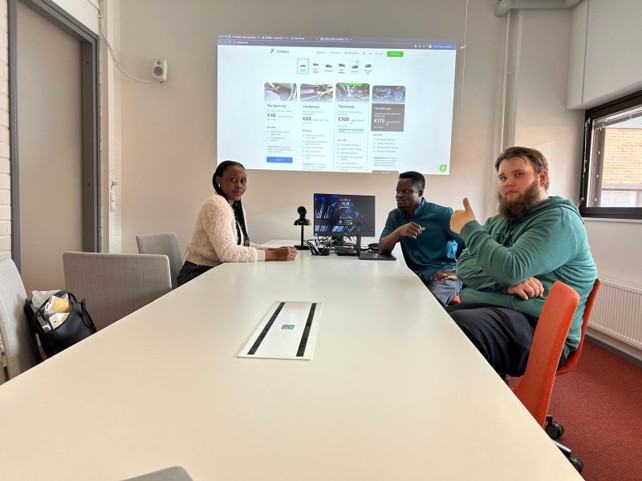
Behind Puhdora are Juho Snicker, Reuben Amedalor and Nwoke Precious. Juho is studying for a Bachelor of Business Administration at Karelia University of Applied Sciences and brings previous experience in vehicle cleaning. Reuben is a doctoral researcher at the University of Eastern Finland’s Department of Physics and Mathematics. Reuben’s earlier startup, fotonLink, focuses on making collaboration easier in the photonics industry. Precious is a computer science graduate of the University of Eastern Finland and supports the marketing side of the business.
A JoES event connected the founders and turned an idea into a team
The team began to take shape at a Joensuu Entrepreneurship Society (JoES) Taco Thursday, where Reuben pitched the business idea and Leo Eronen, a JoES board member, became interested. When Reuben later looked for someone with experience in car cleaning, Leo introduced him to Juho. “We had a meeting together and then became partners afterwards,” Reuben recalls. He describes Juho as bringing “a different energy, commitment and Vision in driving the project forward.” Precious later joined to help with marketing.
Joensuu Entrepreneurship Society has been undergoing a revival since 2025. Taco Thursdays are among the activities that have brought entrepreneurially minded students from different fields together. Reuben’s story is a strong example of how these grassroots activities can matter. A key factor was Leo Eronen’s role as a connector who brought two people together. Research shows how important people like Leo are to the well-being of an entrepreneurial ecosystem.
Registering Puhdora turned the idea into an official company
The company was registered through PRH. The team used the registration process as an opportunity to choose a more commercial name and selected Puhdora. They registered the company under Car fixing and maintenance because it was the closest available industry classification to their business idea. They also opened a bank account with Holvi because it best suited their needs.
The process also showed how carefully a new company’s administrative details must be handled. Choosing the wrong industry could have prevented the team from operating as a car cleaning company, and completing the registration information required frequent switching between Finnish and English. In their experience report, the team summed up the importance of the step: “The company registration was an important step because it made the business more official and gave us experience with the administrative side of running a company.”
Registration timing depends on team readiness and the ability to accept payments
When should a company be registered? It depends on many factors. If the idea has been developing for a long time and the team members know each other well, registration can happen sooner. If the idea is relatively new and the team members do not yet know each other well, it may be better to experiment with and pilot the business idea first. In some cases, however, forming a company is the only way for the team to accept payment legally from pilot customers.
Real customer jobs helped the team test and speed up the service
During the development period, the team completed two additional interior-cleaning jobs to gain practical experience and test the business idea. The first vehicle they documented with photos was a bus. A few friends joined them so they could see how the work should be organised, and the team cleaned from the back of the bus towards the front. The second job was a hatchback with minor interior wear. During that job, they also tested a basic vinegar compound for scent removal. “The additional cleaning jobs were useful because they allowed us to test our service with real customers and gain more practical experience,” the team wrote.

The jobs also helped the team improve scheduling and customer communication. They used email and phone calls for the bus job and WhatsApp for the hatchback client. “We also learned that communication with customers is an important part of the service,” they reflected.
Process changes cut total cleaning time by 27 percent
The process analysis produced measurable changes. Detailed measurements in the report showed that total cleaning time fell from 110 minutes to 80 minutes, a reduction of approximately 27.3%. Preparation time fell from 15 minutes to 5 minutes, and cleaning time fell from 90 minutes to 70 minutes, while the number of workers remained at two. Faster vacuuming and more focused window cleaning made the tasks easier to organise, improved cleaning quality, reduced unnecessary movement and preparation time, and clarified the division of work between team members.
Service speed and quality can determine whether the business is viable
Moving from market research and small-scale tests to actual service or product trials is important because those trials produce a different kind of learning. To become profitable, a team often needs to find ways to deliver its service faster and to a higher standard. Customers also value speed and quality in many services. The difference between serving six and eight customers per day can determine whether a business is viable and profitable.
The GrowthBASE application sharpened the team’s growth priorities
Puhdora applied to Business Joensuu’s GrowthBASE Startup Coaching Program as part of its efforts to develop and grow the company. The team was accepted into the accelerator. During the application, the team familiarised itself with the programme and considered how it could support the development of the business.
GrowthBASE focuses on scalable business operations, growth opportunities, prioritisation and the development of a clear action plan. These themes are relevant to Puhdora’s current stage as the team prepares the business for future growth. As the team put it: “We also gained a better understanding of the importance of having clear goals and priorities when developing a growing business.”
GrowthBASE connects startup coaching with future funding opportunities
In Joensuu, GrowthBASE is part of a long chain of incubator and accelerator services that Business Joensuu and its predecessor have provided since the early days of Joensuu Science Park in the 1990s. Today, the accelerator helps startups move from a minimum viable product (MVP) towards scalability. It also provides an important source of deal flow for the new North Karelia Growth Fund II investment fund. Put another way, the accelerator may help Puhdora assemble a funding package that includes investment from the new fund.
Social media showed that visibility requires consistent work
To build visibility and make Puhdora easier for potential customers to find, the team created accounts on TikTok, Facebook, Instagram, YouTube and LinkedIn. They also began producing marketing material to introduce Puhdora, showcase its services and attract new customers, adapting the content to the format and audience of each platform.

The experience changed how the team thought about marketing. “Creating the social media presence showed us that marketing is an important part of developing the business. Simply having social media accounts is not enough; we also need to create consistent and suitable content and keep the accounts active.” Short videos can be used on TikTok and Instagram, while LinkedIn can carry more professional, business-related content. The team’s next steps are to continue creating content, publish regularly, test which formats receive the most attention, increase awareness of Puhdora and use social media to reach potential customers.
VAT registration brought pricing and administration into focus
The team reviewed Puhdora’s VAT situation and began registering for VAT with the Finnish Tax Administration, Vero. As of the report dated 30 August 2026, the registration was still in progress, and the team was waiting to receive the company’s official VAT ID. At the same time, the team updated the pricing on Puhdora.com so that the prices shown to customers include VAT.
The work made the financial and administrative side of the business more concrete. “Through this process, we learned more about how VAT affects our business and pricing,” the team wrote. The team also learned that tax changes can directly affect service pricing and that the company and website information will need to be updated once the VAT registration is confirmed.
The team sees potential, but more testing is still needed
The practical work has moved Puhdora from planning toward real-world testing, while showing where the business still needs to develop. The team wrote: “We believe the business idea has potential, but we still need more experience and testing to improve our processes and make the business even more efficient.”
Explore the Draft program’s application guidelines and apply in Joensuu , Kuopio or Savonlinna!
Puhdora’s participation in the Draft Program was supported by the Otsakorpi foundation.